Who Owns the Most Bitcoin: Exclusive Facts & Best List
Why “Who Owns the Most Bitcoin?” Is Hard to Answer
Bitcoin uses pseudonymous addresses. An address shows a balance, but it does not show a legal name. One person can control hundreds of addresses, and one company wallet can hold funds for millions of users. This structure makes precise rankings impossible, yet large holders still leave visible footprints.
Analysts group top holders into major categories: the original creator, early miners, exchanges, public companies, funds, governments, and private “whales.” Together, these groups hold a big share of all mined Bitcoin, but no single party controls the entire network.
Satoshi Nakamoto: The Largest Known Individual Holder
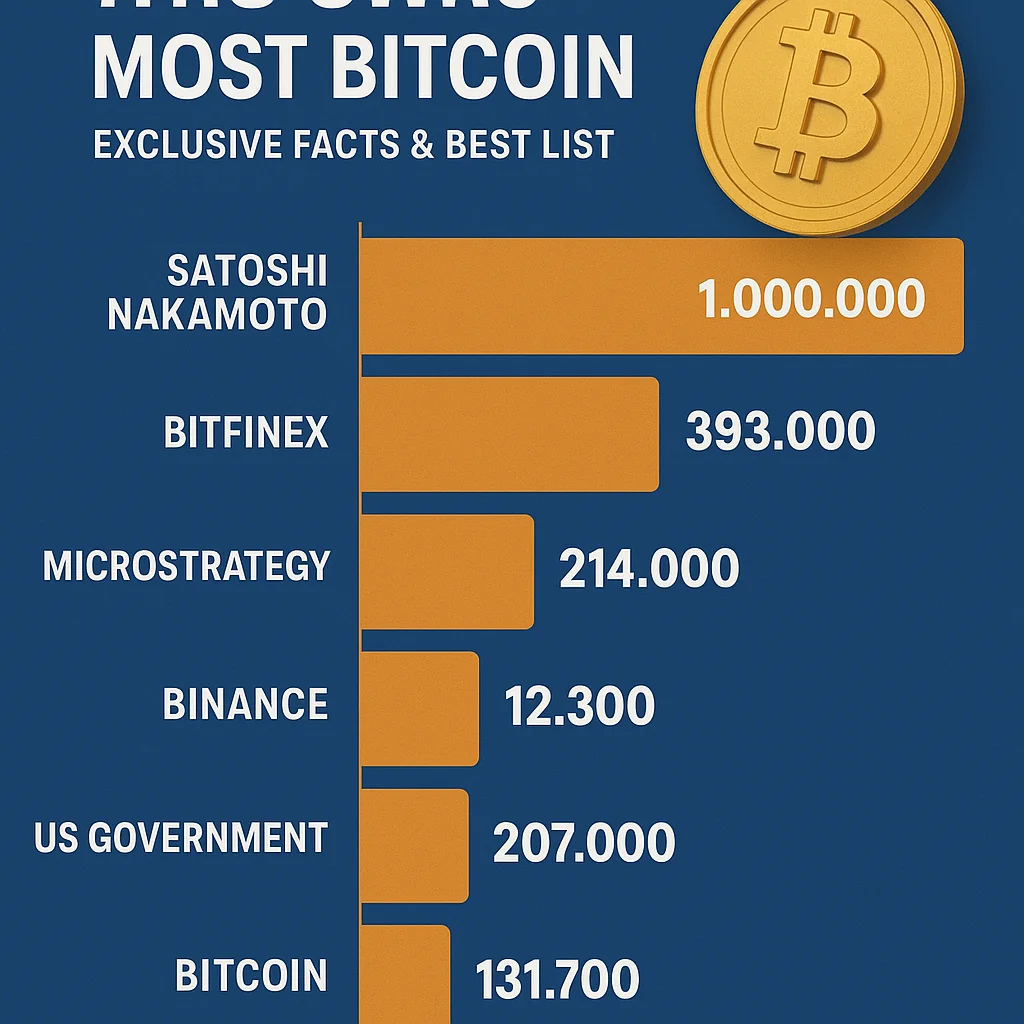
Satoshi Nakamoto, the anonymous creator of Bitcoin, is widely believed to be the largest individual holder. Research into early mining patterns suggests Satoshi mined about 1 million BTC in the first year of the network.
Those coins sit in early addresses that have never moved in over a decade. At a price of $50,000 per BTC, that stash would equal about $50 billion. Because no court, exchange, or public filing links those wallets to a real identity, Satoshi’s holdings stay frozen and untouched, yet they still count as a major part of Bitcoin’s supply.
Bitcoin Ownership by Category
Even if single-address rankings shift every day, broad categories change more slowly. The table below shows an approximate picture of who controls large pools of Bitcoin.
| Holder Category | Estimated BTC Held | Example Holders | Ownership Notes |
|---|---|---|---|
| Creator / Early Miner | ~1,000,000 BTC | Satoshi Nakamoto | Coins mined 2009–2010, never moved |
| Centralized Exchanges | ~2,000,000–3,000,000 BTC | Binance, Coinbase, OKX, Bitfinex | Custody for millions of customers |
| Public Companies | ~1,000,000+ BTC | MicroStrategy, Tesla (historical), Marathon | Reported in corporate filings |
| ETFs and Funds | ~1,000,000+ BTC | BlackRock iShares, Grayscale, Fidelity | Back assets for fund shares |
| Governments | ~200,000–300,000 BTC | US, UK, Germany (seized coins) | Often held after law enforcement actions |
| Private Whales & Early Adopters | Millions of BTC spread over wallets | Unidentified large holders | Control high-value addresses, often fragmented |
These ranges shift as markets move, new ETFs launch, and governments auction seized coins. Still, they offer a useful map for understanding where large pockets of Bitcoin sit right now.
Centralized Exchanges: The Largest Aggregate Holders
Centralized exchanges like Binance, Coinbase, and Bitfinex hold more Bitcoin than any single private investor. On-chain data points to some exchange wallets with hundreds of thousands of BTC each.
These coins do not belong to the exchanges alone. They include customer deposits from traders, long-term holders who use exchange custody, and businesses that buy through exchange accounts. If you keep Bitcoin on a big platform, your coins likely sit inside one of these massive pooled wallets.
Why Exchange Wallets Are So Large
Exchanges pool deposits to cut costs and simplify operations. Instead of one address per user, they keep master wallets and shuffle coins internally. This system keeps withdrawal fees lower and speeds up transfers inside the platform.
The downside is concentration risk. A single hack, failure, or regulatory freeze can affect millions of users at once. That is why the crypto phrase “not your keys, not your coins” became so common after large exchange collapses.
Public Companies with the Most Bitcoin
Since 2020, several listed companies started to treat Bitcoin as a treasury asset. They report their holdings in quarterly filings, so their stacks are well documented compared with anonymous whales.
Some of the most discussed corporate holders include business intelligence firms, crypto miners, and payment companies that once stored large reserves in BTC.
Top Public Corporate Holders (By Strategy and Profile)
Public company holdings shift as they buy, sell, or raise capital. Still, a few names keep showing up in any ranking of large corporate holders.
- MicroStrategy (MSTR) – Famous for its aggressive Bitcoin strategy, with hundreds of thousands of BTC accumulated using corporate cash and debt.
- Bitcoin Mining Companies – Firms such as Marathon Digital and Hut 8 often keep part of their mined coins on balance sheets.
- Payment and Tech Firms – Some companies, like Tesla in the past, have bought Bitcoin as part of treasury experiments or strategic bets.
These corporate piles do not rival the largest exchange wallets, yet they matter because they are public and audited. That transparency helps investors track institutional adoption.
ETFs and Trusts: Institutional Giants
Spot Bitcoin ETFs and long-running trusts control huge shares of circulating supply. Grayscale’s Bitcoin Trust was an early giant, holding over 600,000 BTC at its peak. New US spot ETFs launched by BlackRock, Fidelity, and others rapidly accumulated tens of billions of dollars in Bitcoin.
These funds pool money from retail investors, advisors, and institutions that prefer regulated products over direct coin custody. One share of an ETF or trust represents a slice of an underlying pool of Bitcoin stored in cold wallets.
Why ETF Holdings Matter for Ownership
ETFs change how Bitcoin ownership appears on paper. Legally, a fund or trust owns the coins. Economically, thousands of shareholders gain price exposure. This setup concentrates on-chain ownership under a small set of custodians, while investment risk spreads across many investors.
If you buy a Bitcoin ETF in a retirement account, you add to these large holdings, even though your name never touches the blockchain itself.
Government Bitcoin Holdings
Several governments hold Bitcoin, often after seizing coins in criminal cases. The United States, Germany, and the United Kingdom control some of the largest state-held stashes. These coins usually sit under law enforcement or treasury departments until courts decide their fate.
Governments rarely buy Bitcoin on the open market. Instead, they auction seized coins or move them over time. When a large wallet labeled as a government address sends coins to an exchange, traders often watch closely, since sales can add extra supply to the market in a short window.
Bitcoin Whales and Large Private Holders
“Whales” are individuals or entities that hold large amounts of Bitcoin, often thousands of coins or more. Many built their positions by mining or buying early, when BTC traded for a few dollars or less.
These holders rarely reveal their names. Analysts spot them through patterns such as large, old wallets that move coins during key price events, or clusters of addresses that move in sync. A single wealthy investor might control dozens of wallets to reduce attention and risk.
Typical Traits of Bitcoin Whales
Whales are diverse. Some are early cypherpunks, others are hedge funds, family offices, or entrepreneurs who made a concentrated bet. Still, their behavior often shares a few patterns.
- They spread holdings across many addresses to reduce single-point failure.
- They favor hardware wallets and offline storage over exchanges.
- They move coins infrequently, often during major market shifts.
- They sometimes test with small transfers before moving large sums.
For an everyday holder, these patterns show why blockchain analysts can estimate whale activity without knowing the people behind the wallets.
Is Bitcoin Ownership Too Concentrated?
Bitcoin critics often argue that ownership is too concentrated. A small share of addresses hold a large portion of total supply. At first glance, this looks like a major centralization risk.
Yet a single address does not always mean a single owner. Exchange wallets may contain deposits from millions of users. ETF custody addresses may represent tens of thousands of investors. When analysts adjust for known exchange and fund wallets, ownership appears more spread out across the globe.
What Concentration Means for Price and Power
Large holders can move markets if they sell in size. A whale dumping tens of thousands of BTC on an exchange in one day will likely push price down. On the other hand, whales who hold for many years reduce active supply, which can support prices over time.
From a power standpoint, no holder can change Bitcoin’s rules alone. They still need miners, developers, and network participants to accept any change. Ownership concentration shapes price more than it shapes protocol control.
How to Check Who Holds Large Amounts of Bitcoin
Anyone can inspect Bitcoin ownership patterns using public tools. Blockchain explorers and on-chain analytics services help reveal large addresses, even though they stay pseudonymous.
To get a basic view, many users follow a simple process.
- Open a blockchain explorer and search for “Bitcoin rich list” or largest addresses.
- Check which wallets are labeled as exchanges or known entities.
- Compare these addresses with data from ETF filings and corporate reports.
This method will not uncover private names, yet it gives a clear sense of how much sits with exchanges, funds, and long-term whale wallets at any given time.
Who Really Owns the Most Bitcoin?
No single person or company “owns Bitcoin” in the sense of full control. Instead, the largest pools sit with a mix of creators, custodians, institutions, and anonymous whales. Each group plays a different role in price discovery, liquidity, and long-term supply.
For individual investors, the most useful insight is simple. While huge wallets exist, a large share of supply is spread across millions of smaller holders who use exchanges, ETFs, and personal wallets. Understanding that mix gives better context for risk, market moves, and Bitcoin’s claim to be a decentralized asset.